How to check tyre treads
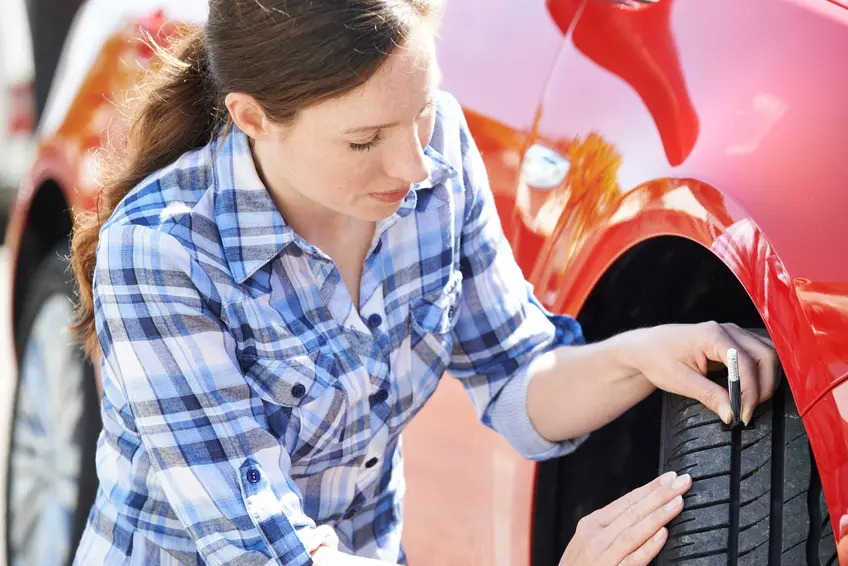
When you own a vehicle, it’s your responsibility to make sure it stays in good condition, helping to keep yourself and everyone around you safe when you take to the roads. But sometimes, it can be tricky to remember all the little checks and measurements you should be taking so you can spot when your vehicle needs a bit of work done.
In this article, we’ll run through the best methods for checking your tyre tread depth, as well as touching on other checks you can do at the same time and clarifying the legal requirements when it comes to tyre maintenance and safety. Keep reading to learn more.
How to measure tyre treads
As a vehicle owner, you’re probably aware that your tyres have something called ‘treads’ – this refers to the patterns on the road-touching surfaces of your tyres that help to maintain traction.
On a brand new tyre, these patterns are held in relief, with deep gaps between them – almost like a hedge maze viewed from above. But as you put them through a bit of natural wear and tear by driving, the rubber begins to wear away. In time, the depth of the tread decreases until the tyre is ‘bald’ – in other words, the relief patterns have worn away.
Important! Your tyres don’t always wear down equally – problems with your wheel alignment can cause one side of a tyre to wear down more quickly than the other. Because of this, it’s vital to inspect the whole middle three-quarters of your tyre surface, and to get your wheels’ alignment checked regularly.
Why is that a problem? Well, worn away treads equals less traction on the road surface, so you could easily go slipping and sliding into a collision – particularly in wet conditions. Tyre tread depth is also something that’s checked on an MOT, so there can be expensive consequences if your tyres aren’t up to scratch. But we’ll get into that a bit later.
First, let’s look at how you can check the tread depth of your tyres quickly and easily. There are three main methods:
- The 20p test
- Check the wear indicators (if applicable)
- Use a depth gauge tool.
The 20p test
As the name suggests, this handy trick involves the use of a 20p coin as a simple gauge for your tread depth. Take a 20 pence coin – another good reason to keep a small amount of change in your glovebox – and place it on its edge into the tread on your tyre.
Now, a 20p coin is designed with a small border band around the outside of the coin face, encircling the monarch’s head. This is the face you want to be looking at – heads, not tails.
If, when you put the coin in position in the tyre tread, you can see that outer band on the bottom edge where the coin meets the tyre, then your treads aren’t deep enough. In a safe tyre, the outer band would be hidden from view.
Of course, this trick only really provides an estimate, but if your treads fail the 20p test, it’s time to get them checked and, if needed, replaced at your local autocentre. As it only takes a few seconds, this test is ideal to carry out before journeys – check it every two weeks and before any long drive.
Checking the wear indicators
Think that trick was handy? This one can be even easier – you don’t need any tools or coins at all, but unfortunately it can’t be done with all tyres.
Some tyres have markers on the rubber itself which let you know the minimum tread depth. If this is the case, you can easily check to see how your treads compare. If they’re at or below those markers, then it’s time for a replacement.
Don’t have tyre indicators? Don’t worry. You can still use your 20p coin or a tread depth gauge as explained below.
Using a depth gauge tool
As the name suggested, a tread depth gauge is a purpose built tool designed to help you check the depth of your tyre treads. Coming in both analogue and digital formats, these tools will allow you to measure the depth of your treads in millimetres – in other words, you get a more accurate measurement than a 20p coin can offer.
An analogue gauge looks a bit like a metal pencil with a disc around it. The probing end of it is retractable – you place this into the tyre tread and push down until the disc is flat against the surface of the tyre. Then you measure the reading on the scale provided.
Digital versions work in much the same way, except they provide a reading on a little screen so you don’t have to read the scale. You might find a digital tyre tread gauge is combined with a tyre pressure checker for dual functionality.
Other convenient checks
If you’re going out to check your tread depths, it’s worth knowing there are a few other fast and simple checks you can do as well to make the most of your time. As mentioned, you can often get multipurpose digital tools that measure tyre pressure as well as tread depth, so this is a great opportunity to check both.
You could also:
- Check your tyres for visible damage such as cuts, cracks or bulges
- Assess your spare tyre’s condition so it’s ready when you need it
- Inspect your windscreen wipers for visible damage
- Make sure all your lights are working properly
- Check liquid levels – fuel, oil, coolant and screenwash.
What is the legal minimum depth of tread for car tyres?
Now that you know how to check your tyre tread, you need to know how low it can get before a replacement is required. The legal regulations are a bit more specific than ‘about the size of the outer band of a 20p coin’, so it pays to know the details if you’re worried your tyres might be getting too worn.
Legally speaking, the minimum tread depth you can safely have on your tyres is 1.6mm. Your tyres must meet this minimum all the way around, across the middle three quarters of the tyre. If you’re not sure what this means, the easiest thing is to ask a qualified mechanic to show you – because getting this right is key.
Not only does it affect road safety if your tyres are bald, but it can fail your MOT. And if you’re caught driving on bald tyres, you can incur a fine of £2,500 and three penalty points on your licence – per tyre. So, if all your tyres are bald, you might have to pay £10,000 and lose your licence entirely.
What we’ve just discussed here is the legal minimum – so as long as your tyres have a greater tread depth than that, you won’t get a fine or fail your MOT. But many experts believe that this depth still compromises road safety. Because of this, it’s recommended to replace your tyres once they get to 3mm or lower.
Not sure you’ve quite got the hang of tread depths? Don’t worry. If you’re at all concerned about your tyres or would like an expert opinion, a trained mechanic will be happy to give them the once over for you to ensure you and everyone else is safe on the road.
UPDATED
