What is a dual clutch transmission?
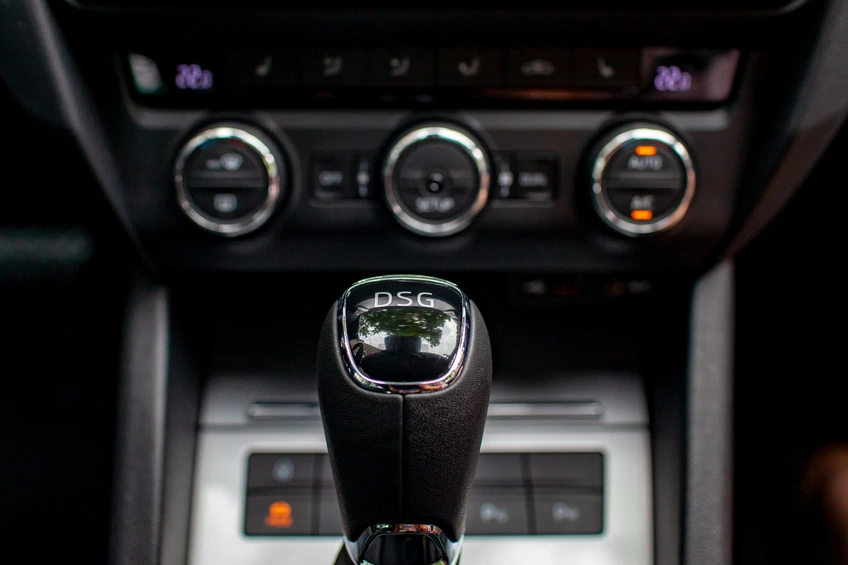
If you’ve been car shopping recently or browsing newer cars, you may have seen the term dual clutch transmission (DCT) popping up here and there and wondered what it actually means. It’s becoming an increasingly common feature in modern vehicles, especially those that aim to balance performance with everyday driving comfort.
In this blog, we take a closer look at how a dual clutch transmission works and what makes it different from other types of gearboxes.
What is dual clutch transmission?
A dual clutch transmission, often shortened to DCT, is an automated gearbox that combines elements of both manual and automatic systems. Unlike a traditional manual car, there is no clutch pedal for the driver to operate, as gear changes are handled electronically.
Depending on the manufacturer, a dual clutch transmission may also be referred to by a different name. For example, in Volkswagen Group vehicles (VW, Audi, Skoda, SEAT, CUPRA) it is commonly known as a Direct Shift Gearbox, or DSG and in Ford vehicles, it is commonly known as a PowerShift gearbox.
For drivers, this means fast and smooth shifts without the need to change gear manually. Many people find a DCT or DSG offers a more responsive feel than a conventional automatic, while still providing everyday convenience.
DCT and DSG gearboxes are often found in performance focused vehicles, but they are also common in everyday family cars. Many manufacturers use them to improve fuel efficiency while maintaining responsive acceleration.
How does a dual clutch transmission work?
A dual clutch transmission works by using two separate clutches to manage gear changes more efficiently.
One clutch controls the odd numbered gears, while the other controls the even numbered gears. While one gear is engaged and delivering power to the wheels, the next gear is already pre-selected by the second clutch.
Because the next gear is prepared in advance, the system can switch between gears very quickly. This reduces the interruption in power that you might notice in a manual gearbox during a gear change.
Dual clutch systems come in different types. Some use a wet clutch, where the clutch plates sit in transmission fluid to help control heat. Others use a dry clutch, which does not use fluid and is common in smaller or lower-torque vehicles. Both designs have their own benefits, but they are made to provide fast, smooth gear changes and manage wear and performance.
Modern DCT systems are controlled by onboard computers that monitor speed, throttle input and driving conditions. The system selects the most appropriate gear automatically to support both performance and efficiency.
Are dual clutch transmissions automatic?
From a driver’s perspective, dual clutch transmissions are essentially the same as an automatic – you don’t need to operate a clutch pedal and the vehicle will shift gears on its own. This means that for everyday driving the experience is very similar to using a conventional automatic.
Technically, the internal mechanics are closer to a manual-style transmission with two clutches rather than a torque-converter-based automatic. However, the lack of a clutch pedal and the automatic gear selection mean they are classed and sold as automatic cars in the UK.
While DCT systems offer quick and smooth gear changes at speed, some drivers notice they can feel slightly different at very low speeds. For example, during slow traffic or parking manoeuvres, the transmission may feel more like a manual as the clutches engage and disengage.
This is a normal characteristic of the design and not usually a fault. Understanding this can help to set expectations if you’re test driving or looking to purchase a vehicle equipped with this type of gearbox.
DCTs are becoming increasingly common in modern cars because they blend smooth automatic convenience with the rapid, responsive shifts associated with performance vehicles. The system is more complex than traditional gearboxes, but it offers a driving experience that many people love.
Just like any other transmission, a DCT needs regular care and maintenance. Getting it serviced on schedule and making sure the software is up to date will help it to stay in good condition – so you can enjoy that smooth convenience for longer.
Need your DSG, DCT or PowerShift repaired or checked? Get in touch with your local autocentre today.
UPDATED
